
1. The Multi-Billion-Dollar "Black Box": Why Upload-Only Music Distribution Fails
Every year, more than $2.5 billion in global digital streaming, mechanical, and neighboring rights royalties enter what entertainment attorneys and collection societies refer to as the "Black Box" — an escrow pool of unallocated revenue that cannot be matched to a verified rights-holder. Contrary to popular belief among independent recording artists, uploading a WAV file and cover art through a retail $20-per-year consumer aggregator does not constitute Music Metadata Admin.
Consumer upload platforms are engineered solely to deliver audio files to Digital Service Providers (DSPs) such as Apple Music, Spotify, TIDAL, and Amazon Music. They do not reconcile underlying musical work identifiers (ISWCs) against sound recording identifiers (ISRCs), nor do they execute SoundExchange Letters of Direction (LODs), verify GS1 US barcode chain-of-title, or clear multi-track broadcast stems for film and television synchronization. When any link in that metadata chain is broken or contradictory, automated DSP and society ingestion engines freeze the royalty stream or disqualify the recording from commercial sync licensing altogether.
Distribution is merely logistics; Music Metadata Administration is ownership architecture. Without an unbroken cryptographic and registry link between your Sound Recording (Master) and Musical Work (Publishing), every stream generates uncollected leakage.
2. Pitfall #1: Aggregator-Assigned ISRC Lock-In vs. Owning a Direct US ISRC Prefix
The International Standard Recording Code (ISRC) is the permanent 12-character alphanumeric fingerprint assigned to a specific sound recording or music video. One of the most common music distribution pitfalls occurs when an independent artist checks the box allowing a low-tier DIY distributor to "generate a free ISRC."
When a third-party aggregator generates an ISRC on your behalf, the first five characters of that code (Country Code + Registrant Code) belong to the aggregator's corporate entity — or worse, a sublicensed bulk pool. This creates three severe operational hazards:
- Catalog Migration Friction: When you migrate your catalog to a major-backed distribution pipeline (such as Virgin Music Group / Ingrooves), retail aggregators frequently flag or block re-delivery of their proprietary ISRC prefixes, forcing inexperienced artists to issue new ISRCs and wipe out historical DSP stream counts and algorithmic playlist velocity.
- Neighboring Rights Ambiguity: International neighboring rights societies and SoundExchange rely on the ISRC registrant prefix to verify the Sound Recording Copyright Owner (SRCO).
- Stem & Version Collision: Sync licensing requires distinct, sequentially governed ISRCs for the Main Commercial Master, Clean Radio Edit, TV Track (Instrumental + Backing Vocals), Full Instrumental, and Acapella stems.
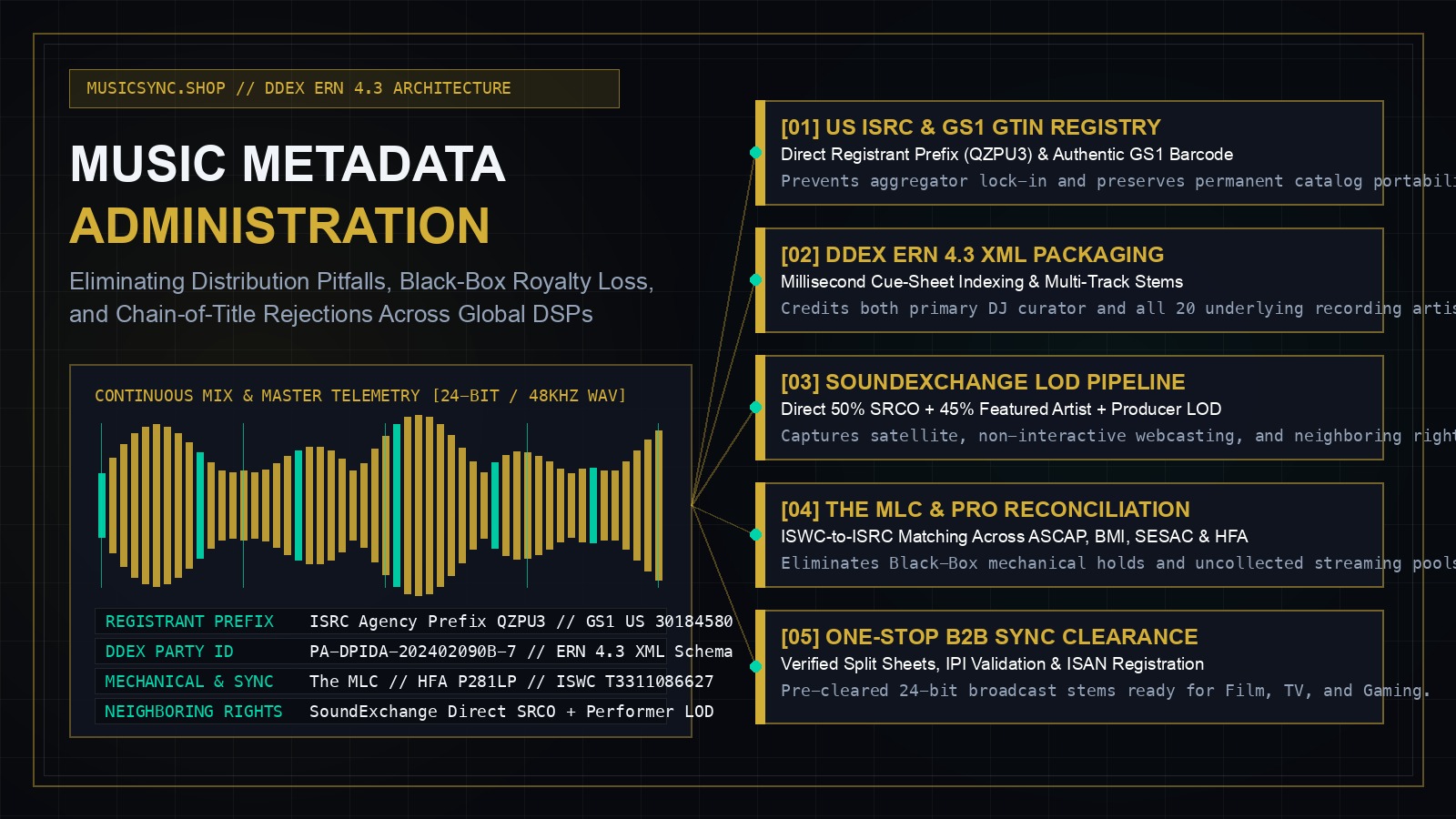
The Administrative Fix: Every serious imprint must secure a direct Registrant Code issued by the official US ISRC Agency (administered by RIAA). At BeigeSound Records, all sound recordings and continuous mix segments are governed under our direct registrant prefix (QZPU3, e.g., QZPU32300001 for DJ Beige's lead single "The Heist"), ensuring 100% sovereign title portability across all global territories.
3. Pitfall #2: Rented Barcodes vs. Authentic GS1 US Company Prefix & GTIN/UPC Ownership
Just as ISRCs identify individual sound recordings, the Universal Product Code (UPC / 12-digit GTIN) or European Article Number (EAN / 13-digit GTIN) identifies the commercial release package (album, EP, single, or continuous DJ mix volume). Many budget distributors assign recycled or internal sub-barcodes that are not registered under the label's legal corporate entity in the global GS1 US database.
When Luminate (formerly Nielsen SoundScan / MRC Data), Billboard, or major DSP editorial systems audit a release, mismatched GS1 prefix ownership can prevent chart registration and trigger automated takedowns during distributor transitions.
The Administrative Fix: Register your UPC/GTIN directly through GS1 US under your corporate entity (such as Mestizo Media Group, Inc., GS1 Account 30184580, Primary GTIN 00884400963741 / 197644736584). Every DJ curator onboarding a volume into the BeigeSound Continuous Mix Program is guided to obtain a verified GS1 US Single GTIN registered in their own legal or corporate name, establishing verifiable commercial provenance from day one.
4. Pitfall #3: Unindexed Audio Uploads vs. DDEX ERN 4.3 XML Continuous Mix Packaging
For decades, DJs, mixtape curators, and compilation producers faced an impossible choice: upload a 60-minute continuous mix to informal streaming sites for zero commercial royalties, or watch DSP copyright filters reject the mix entirely for unauthorized master usage.
Under modern DDEX Electronic Release Notification (ERN 4.3) standards — the XML communication protocol governed by the Digital Data Exchange (DDEX) consortium — a commercial release is not delivered as a flat audio file. Instead, an enterprise DDEX Party ID holder (such as BeigeSound Records / Mestizo Media Group, PA-DPIDA-202402090B-7 and PA-DPIDA-202605200B-K) transmits a structured XML manifest alongside the 24-bit/48kHz broadcast masters.
As proven by the landmark release of Eugene O. Smith Jr. (DJ Beige)'s DMV Top 20 Vol. 1 (DJ Mix) distributed globally via Virgin Music Group and Ingrooves, proper DDEX ERN 4.3 XML packaging binds every millisecond transition marker, underlying track ISRC, composer IPI number, and publisher split directly into the release container. When a listener streams the continuous mix on Apple Music or Spotify, the DSP plays a seamless gapless experience while routing statutory master and publishing royalties to all 20 underlying recording artists and songwriters simultaneously.
5. Pitfall #4: Unclaimed Digital Performance Royalties & SoundExchange Letters of Direction (LODs)
Many independent artists confuse interactive on-demand streaming (Spotify, Apple Music) with non-interactive digital audio transmissions (SiriusXM satellite radio, Pandora, iHeartRadio digital, cable TV music channels, and international neighboring rights). Under U.S. statutory copyright law (17 U.S.C. Section 114), non-interactive digital performance royalties are collected and distributed exclusively by SoundExchange according to a strict statutory formula:
- 50% to the Sound Recording Copyright Owner (SRCO): The record label or master owner who funded and owns the P-line master recording.
- 45% to the Featured Recording Artist(s): The primary credited performer(s) on the track.
- 5% to Non-Featured Vocalists and Musicians: Distributed via the AFM & SAG-AFTRA Intellectual Property Rights Distribution Fund.
Two Critical SoundExchange Pitfalls:
- Registering Only as Artist (Losing 50%): Self-released artists who register with SoundExchange only as a "Performer" leave the entire 50% SRCO (Rights Owner) share sitting uncollected in escrow. Independent master owners must register Dual Accounts (both Performer and Rights Owner) and submit complete ISRC repertoire spreadsheets.
- Failing to File Letters of Direction (LODs) for Producers, Mixers & Executive Producers: Traditional distributors cannot pay a record producer or DJ curator their negotiated points out of satellite radio royalties. To honor producer or executive producer royalty points on digital performance revenue, the Featured Artist must execute an official SoundExchange Letter of Direction (LOD) directing a specified percentage of the 45% Featured Artist share directly to the producer's SoundExchange account.
6. Pitfall #5: The Mechanical Royalty Gap — The MLC, Harry Fox Agency (HFA), and ISWC Matching
Every musical recording embodies two distinct copyrights: the Sound Recording (Master) and the Musical Work (Composition/Publishing). Registering a song with a Performing Rights Organization (ASCAP, BMI, or SESAC) covers public performance royalties only. PROs do not collect U.S. digital mechanical royalties generated by interactive streams on Spotify, Apple Music, Amazon, or TIDAL.
Under the Music Modernization Act (MMA), blanket digital mechanical royalties in the United States are administered by The Mechanical Licensing Collective (The MLC) alongside mechanical licensing agencies such as the Harry Fox Agency (HFA) (where BeigeSound / Mestizo Media Group maintains Publisher Code P281LP).
If your musical work is registered at ASCAP or BMI without its corresponding 12-character ISRC attached, The MLC's automated matching engine cannot link the International Standard Musical Work Code (ISWC, e.g., T3311086627) to the streaming sound recording. Those mechanical royalties sit in The MLC's unmatched pool until redistributed by market share to major publishers. Proper Music Metadata Admin requires cross-registering every ISRC inside both your PRO work registration and The MLC portal immediately upon master delivery.
7. Pitfall #6: Unverified PRO Split Sheets & Commercial Sync Disqualification
In high-value B2B synchronization licensing — placing music in feature films, network television, streaming series, advertising campaigns, and AAA video games — metadata errors are fatal. Music supervisors work on compressed post-production deadlines. When a supervisor selects a cue, they require instantaneous proof of 100% One-Stop or Pre-Cleared Chain of Title.
If a track has three co-writers across BMI and ASCAP whose IPI/CAE numbers are missing, whose split percentages add up to 110% or 85%, or who contain an uncleared third-party loop, the music supervisor will drop the track within minutes and replace it with a pre-cleared master from a catalog like MusicSync.shop.
At MusicSync.shop, every catalog entry is backed by:
- Signed, timestamped Split Sheets containing verified writer and publisher IPI/CAE numbers summing to exactly 100.00%.
- International Standard Audiovisual Number (ISAN, Account
130025) and International Standard Name Identifier (ISNI0000000514382625) cross-indexing. - Time-aligned 24-bit / 48kHz broadcast multi-track stems (Full Mix, Instrumental, TV Track, Drums, Bass, Melodic, and Lead Vocals) normalized to
-14 LUFS/-1.0 dB True Peak.
8. Enterprise Comparison: DIY Upload Aggregators vs. BeigeSound / MusicSync.shop Metadata Architecture
| Compliance Dimension | Retail DIY Upload Aggregators | BeigeSound & MusicSync.shop Enterprise Standard |
|---|---|---|
| ISRC Registrant Code | Leased / generic aggregator prefix; causes friction during catalog migration. | Direct US ISRC Agency Registrant Prefix (QZPU3) with permanent title portability. |
| UPC / GTIN Barcode | Internal or recycled pool barcodes lacking corporate GS1 provenance. | Authentic GS1 US Company Prefix & Single GTIN ownership (30184580). |
| DDEX Ingestion Standard | Basic flat-track delivery; continuous DJ mixes rejected or demonetized. | Full DDEX ERN 4.3 XML packaging (PA-DPIDA-202402090B-7) with millisecond cue-sheet indexing via Virgin Music Group / Ingrooves. |
| SoundExchange & Neighboring Rights | Unregistered by default; 50% SRCO & producer LOD shares left in escrow. | Dual SRCO + Performer registration and binding Letters of Direction (LODs) filed at source. |
| Mechanical Royalties (The MLC & HFA) | Left to artist guesswork; frequent ISWC-to-ISRC mismatch and black-box loss. | Full ISWC-to-ISRC cross-linking across The MLC, HFA (P281LP), ASCAP, BMI, and SESAC. |
| B2B Sync Licensing Readiness | Stereo MP3/WAV only; zero stem delivery or split-sheet verification. | 100% pre-cleared 24-bit/48kHz discrete broadcast stems, verified IPI split sheets, and ISAN (130025) readiness. |
9. How to Audit & Remediate Your Catalog with BeigeSound Executive Consulting
Whether you are an independent recording artist preparing a flagship album, a regional DJ curating a commercial 60-minute continuous mix volume, or an independent label executive auditing years of uncollected back-catalog royalties, establishing institutional-grade Music Metadata Administration is the highest-ROI investment in the modern music business.
Led by Eugene O. Smith Jr. (DJ Beige), BeigeSound Records and Mestizo Media Group, Inc. provide direct executive metadata administration, DDEX ERN 4.3 onboarding, and global sync preparation at a standard executive consulting rate of $300/hour (non-negotiable), structured into three turnkey activation packages:
- Tier 1 — Starter Metadata Compliance Package ($1,650 // 5.5 Hours): Direct US ISRC prefix setup, GS1 US GTIN barcode registration, PRO (ASCAP/BMI/SESAC) work audit, and SoundExchange Dual Account setup for up to 5 tracks.
- Tier 2 — Full Label & Catalog Activation ($3,600 // 12 Hours): Complete DDEX ERN 4.3 release preparation, The MLC & Harry Fox Agency (HFA) mechanical linking, SoundExchange Letters of Direction (LOD) drafting, Luminate/Billboard chart registration, and 24-bit broadcast stem archiving for up to 15 tracks.
- Tier 3 — Executive Label Suite & Continuous Mix Pipeline ($4,950 // 16.5 Hours): End-to-end corporate label formation, full 20-track continuous DJ mix DDEX ERN 4.3 millisecond XML indexing, Virgin Music Group / Ingrooves distribution onboarding, ISAN audiovisual sync registration, and priority placement in the MusicSync.shop B2B licensing catalog.
For select high-caliber recording artists and verified DJ curators whose masters meet BeigeSound's broadcast and editorial standards, Eugene O. Smith Jr. offers an Executive Production Partnership: the $300/hr consulting fee is 100% waived in exchange for a 50% Executive Producer master share documented via a binding SoundExchange Letter of Direction (LOD) and distributor royalty split. Qualified DJs can also submit 60-minute continuous mixes at zero upfront cost via BeigeSound.com/submit.